
Na alle waarskynlikheid is T.S. Eliot vanweë sy betrokkenheid by Faber & Faber vanaf 1925 tot en met sy dood in 1965, een van die beroemste uitgewers van digbundels van alle tye. Op Faber & Faber se weblog, The Thought Fox, het ene Robert Brown onlangs dan juis uitvoerig geskryf oor Eliot se betrokkenheid by die uitgewery en die rol wat hy gedurende sy 40 jaar as uitgewer daar gespeel het.
By wyse van inleiding: “Although Eliot had worked in banking and also managed and edited a prestigious cultural journal, The Criterion, he had no illusions about what he was letting himself in for. When he was first offered the job Geoffrey Faber warned Eliot that he needed ‘a man who combines literary gifts with business instincts, who has a wide circle of literary friends, and who is quite as much at home on the lower levels as on the lonely peaks’.”
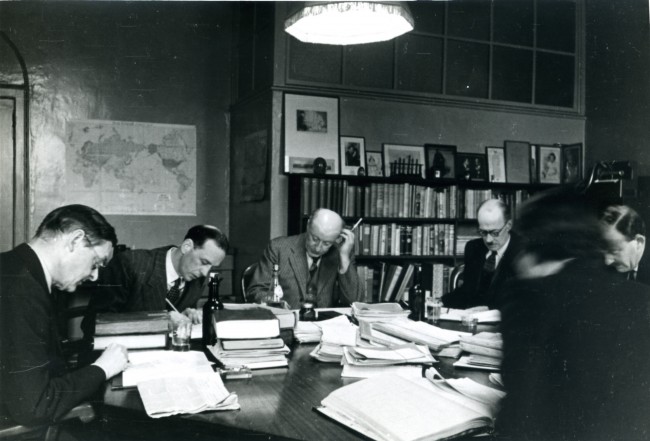
Volgens Brown toon die foto hierbo een van die belangrikste funksies waarby Eliot betrokke was, naamlik die sogenaamde ‘Book Committee’ wat in 1925 deur Sir Geoffrey Faber tot stand gebring is. Dié groep, bestaande uit die direkteure, het elke Woensdag van 11:00 tot satwordens toe vergader: “Faber’s directors meet round a table filled with readers’ reports and bottles of beer. They are deciding what to publish and what not to publish’. Faber’s directors meet round a table filled with readers’ reports and bottles of beer. They are deciding what to publish and what not to publish’.”
Uiteraard is dit veral die verwysing na die bottels bier wat ‘n mens se gedagtes op loop sit, maar volgens Eliot sde biograaf, Frank Morley, het Eliot hom darem stemmig gedra tydens dié vergaderings: “Frank Morley depicts Eliot at these meetings as self-controlled and sagacious. With regard to book proposals he was ‘Conscientious, scrupulous, careful, attentive’ and rarely in a hurry. According to Morley, ‘He had a theory you were not likely to lose money on the books that you didn’t publish. He was extremely perceptive in detecting the right character in manuscripts which might have been thought beyond his range. He made mistakes, of course, but his mistakes as a rule were not costly, and some of his far shots paid well’.”
Dit is egter Eliot se meer as 500 leesverslae aan die komitee wat vir die navorser van belang is; deurgaans netjies getik en kenmerkend van Eliot se beskeidenheid en diplomatiese hantering van manuskripte: “He was normally very diplomatic, but the feeble verse that a well-known aesthete had submitted received a terse one-line report: ‘I cannot endure this stuff’. One of Eliot’s most perceptive reports is on the manuscript of In Parenthesis, the great work about the First World War by the poet and artist David Jones, dated September 1936. He does not overstate the importance of the work but draws out the Arthurian and Kiplingesque qualities that he knows will appeal to particular colleagues on the Book Committee. Typically self-deprecatory, he admits his views may not be widely shared: ‘I have not the slightest notion whether what I see in the book is really there, or if it is there, whether it will reach more than a few people’.”
Inderdaad ‘n insiggewende (en vir my fassinerende) oorsig van iemand wat sonder veel aanhef of bravade bykans die hele gang van die (moderne) digkuns verander het.
Die volledige artikel kan hier gelees word.
***