
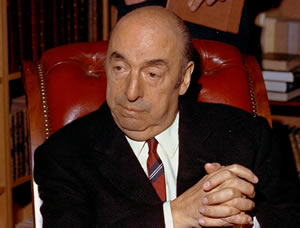
Danksy die inisiatief wat deur die World Poetry Movement (WPM) geneem is, word die lewe en werk van die ikoniese digter Pablo Neruda (foto) môre wêreldwyd gevier. Dit sal gebeur aan die hand van poësievoorlesings, lesings, films en paneelbesprekings in bykans al die vernaamste sentra ter wêreld.
Op hul webtuiste motiveer die WPM hul inisiatief soos volg: “Now, more than ever, life leads us to appreciate and celebrate the life and work of the great Pablo Neruda. His poetry is emblematic of the American telluric. His journey through the world, loaded with history in a conjectural and traumatic time, was the journey of a full human being, conscious of the great problems of a century that suffered the deployment of two world wars and countless indignities caused by the abuse of local authorities in the Americas and the third world in general […]With Pablo Neruda we learned that the poet is an essential part of human life. With his poetry millions of people have qualified their sensitivity, culture and spirit. He was a poet who drastically steered away from art for the sake of art and his contact with the humanity of the people turned him into a real man who nurtured the growth of awareness and trust in the profound transformations towards a world reconciled with life […]To celebrate the memory of Pablo Neruda is to celebrate spiritual, humanistic and poetic acquisitionsthat have consolidated the adventure of a new being to the horizon of afateful time. To celebrate the memory of Pablo Neruda is to remember that the poet takes off the mask of the esthete and is committed to a violated humanity.”
Ter verdere ondersteuning het hulle ook die lang onderhoud geplaas wat Rita Guilbert met die digter gevoer het in Januarie 1970, enkele dae voor hy sy kandidatuur vir die presidentskap van Chili teruggetrek het weens verdeeldheid onder die linkse elemente van die Chileense politiek. (Die onderhoud, wat deur Ronald Christ vertaal is, het uiteindelik in The Paris Review verskyn.”
En dié onderhoud is beslis die moeite werd om te lees, lank en uitgebreid soos hy dan ook mag wees.
Guilbert open die onderhoud besonder netjies met ‘n uitspraak deur Neruda wat hy op 30 September 1969 gemaak het tydens sy aanvaarding van die presidentsbenoeming deur die Chileense Kommunistiese Party: “”I have never thought of my life as divided between poetry and politics. I am a Chilean who for decades has known the misfortunes and difficulties of our national existence and who has taken part in each sorrow and joy of the people. I am not a stranger to them, I come from them, I am part of the people. I come from a working-class family… I have never been in with those in power and have always felt that my vocation and my duty was to serve the Chilean people in my actions and with my poetry. I have lived singing and defending them.”
Inderdaad fassinerende leesstof; van begin tot einde. Die laaste vraag deur Guilbert het hoeka gehandel oor Neruda se bundel Residence on Earth. Van dié gedigte het hy gesê dat dit die mens hoegenaamd nie help om te leef nie, maar om te sterf.
As leestoegif plaas ek sy antwoord volledig hieronder. Gevolg deur die laaste reëls uit die bekende gedig “Spain“. En onthou; stof môre jou Pablo Neruda bundels af en léés ter herinnering aan een van die allergootste meesters in ons wêreldletterkunde …
My book Residence on Earth represents a dark and dangerous moment in my life. It is poetry without an exit. I almost had to be reborn in order to get out of it. I was saved from that desperation of which I still can’t know the depths by the Spanish Civil War, and by events serious enough to make me meditate. At one time I said that if I ever had the necessary power, I would forbid the reading of that book and I would arrange never to have it printed again. It exaggerates the feeling of life as a painful burden, as a mortal oppression. But I also know that it is one of my best books, in the sense that it reflects my state of mind. Still, when one writes-and I don’t know if this is true for other writers-one ought to think of where one’s verses are going to land. Robert Frost says in one of his essays that poetry ought to have sorrow as its only orientation: “Leave sorrow alone with poetry.” But I don’t know what Robert Frost would have thought if a young man had committed suicide and left one of his books stained with blood. That happened to me-here, in this country. A boy, full of life, killed himself next to my book. I don’t feel truly responsible for his death. But that page of poetry stained with blood is enough to make not only one poet think, but all poets. . . Of course, my opponents took advantage-as they do of almost everything I say-political advantage of the censure I gave my own book. They attributed to me the desire to write exclusively happy and optimistic poetry. They didn’t know about that episode. I have never renounced the expression of loneliness, of anguish, or of melancholia. But I like to change tones, to find all the sounds, to pursue all the colors, to look for the forces of life wherever they may be-in creation or destruction.
My poetry has passed through the same stages as my life; from a solitary childhood and an adolescence cornered in distant, isolated countries, I set out to make myself a part of the great human multitude. My life matured, and that is all. It was in the style of the last century for poets to be tormented melancholiacs. But there can be poets who know life, who know its problems, and who survive by crossing through the currents. And who pass through sadness to plenitude.
***
You will ask: why does your poetry
not speak to us of sleep, of the leaves,
of the great volcanoes of your native land?
Come and see the blood in the streets,
come and see
the blood in the streets,
come and see the blood
in the streets!
© Pablo Neruda (Uit: Spain, vertaal deur Robert Christ)