

Die Australiese digkuns is inderdaad ‘n vreemde gedierte op die vlaktes van die internasionale digkuns. Synde bedrywig in ‘n monolinguale kultuur, met ‘n nogal indrukwekkende produksielys daarby, is dit eintlik verbasend hoe min Australiese digters internasionale aansien geniet.
Daarom dat Philip Mead se publikasie, Networked Language: Culture & History in Australian Poetry (2008: Australian Scholarly Publishing), van besondere belang is en tans ook welverdiend heelwat aandag begin kry; soos dit blyk uit Pam Brown se deeglike oorsigartikel by Jacket2. Volgens haar plaas Mead die blaam vir die Australiese digkuns se lae profiel binne internasionale konteks vierkantig voor die deur van die literêre teoretici: “In the Australian context the critical discourse on poetry lags seriously behind, or is out of sync with, the formal innovativeness and linguistic range of historical and contemporary poetry production. It’s as if literary theory and criticism can’t envisage ways forward.”
Mead gaan dan verder en beskryf sy essays soos volg: “In response to this scenario, the essays that follow are experiments in the theory and practice of a kind of contextual reading, in trying to articulate some of the ways in which poetic language is networked with culture and history.”
As sulks is dié aantyging waarskynlik ook net so van toepassing op ons eie situasie waar daar bitter selde metatekste oor ons letterkunde in boekvorm verskyn; tog wel in akademies-geakkrediteerde tydskrifte, maar daartoe het die algemene publiek en liefhebbers van die digkuns, selde toegang. Soos telkens al gesê, is die maak van gedigte ‘n ambag en net soos dit die geval is met enige ánder vakbedryf is dit sekerlik nodig dat die digter op hoogte moet bly met die (nuwe) teoretiese verwikkelinge van sy ambag, is dit nie?
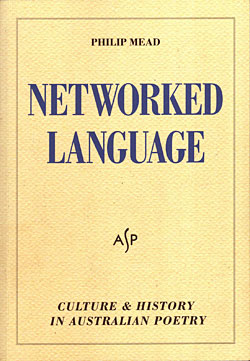
Maar terug na Philip Mead se boek. Reeds met die inleiding is daar die volgende treffende definisie van poëtika wat deur Pam Brown as aanhef tot haar artikel gebruik word: “Poems are made (poesis) out of the solute of ordinary words, even if it is difficult to know exactly how this happens. Broadly speaking, poetics is the name we give to the fractal geometry of textual meanings.”
Die fokus van dié indrukwekkende publikasie word soos volg deur Brown saamgevat: “The phrase ‘culture and history’, from the book’s subtitle, suggests that these essays are sociologically motivated. The essays are not narrowly ‘Australian’, rather they are links, nodes or points of connectivity in a ‘networked language’, a concept perhaps influenced by the notion of Deleuze and Guattari’s rhizomatic mode of knowledge. Mead’s research and approach acknowledges the contribution to literary criticism by theorists from fields other than literature whilst noting the rare use of poetic writings within literary cultural studies. In part, he blames the use (and publication) of poetic texts for teaching purposes and, historically, the reading of these texts as part of the quest for a national identity of this so-recently white-settled country. The identity quest informed the construction of institutional curricula concerning Australian literary studies and its component courses, journals and so on. Mead speculates on how a critical discourse limited by these and other factors led to misinterpretations of some poets’ writings that he re-reads and re-contexualises here.”
Inderdaad ‘n belangrike publikasie met ‘n besonderse uiteensetting deur Brown. Gaan lees gerus die volledige artikel op Jacket2 se webtuiste. Ten spyte van die fokus op bepaalde Australiese digters, is daar genoeg pitkos in weggelê om enige poësieliefhebber tot nadenke te stem. Veral die gedeeltes oor post-koloniale letterkunde en taalvariante was vir my persoonlik insiggewend.
Hieronder volg ‘n gedig deur Lional Fogarty; ‘n gedig wat ook deur Brown in haar artikel aangehaal word.
***
What Saying Says
What saying says
same as laying bout
race as taken us
ace as lag us
pace as sagged us
The still distillery owned
Reliving our black future
is of most greatest to a eye
But the Abo playwriter said
he bro’s you not listens
to noboby not even your
own kind
The sun shone at a cold night’s air
The half moan came over the
body is laying on the frosted
grassed plains
Now the laughter at hate
Laughter at TV crap
Laugh at my world reefed for
a leaving sign
© Lional Fogarty (Uit: Minyung Woolah Binnung, 2004)